I'm an Optometrist. If Your Eye Vitamin Doesn't Have These 3 Things, It's Just an Expensive Multivitamin.
This article is produced by Klaris


A patient set a bottle on my desk last month and asked me a simple question. "Is this a good one?"
It is the question I get more than any other. Someone has been buying an eye vitamin for years, paying a premium for it, and they want to know if it is doing anything.
So I did what I always do. I turned the bottle over and read the back.
It was a multivitamin. A perfectly fine one. Vitamin C, vitamin E, a B-complex, zinc, a long list of minerals.
There was a picture of an eye on the front and the word "vision" in the product name. But the part that would make it an eye vitamin, the part that actually works on the eye, was not there.
This happens constantly. A large share of what gets sold as "eye health" is a general multivitamin wearing an eye costume.
And most people never know, because the only way to tell is to read the back of the label and know exactly what you are looking for.
Here is what you are looking for.
1.What actually makes an eye vitamin an eye vitamin
Your body can get vitamin C and zinc from a normal diet and a standard multivitamin. Those nutrients matter, but they are not what separates an eye vitamin from a grocery-store multi.
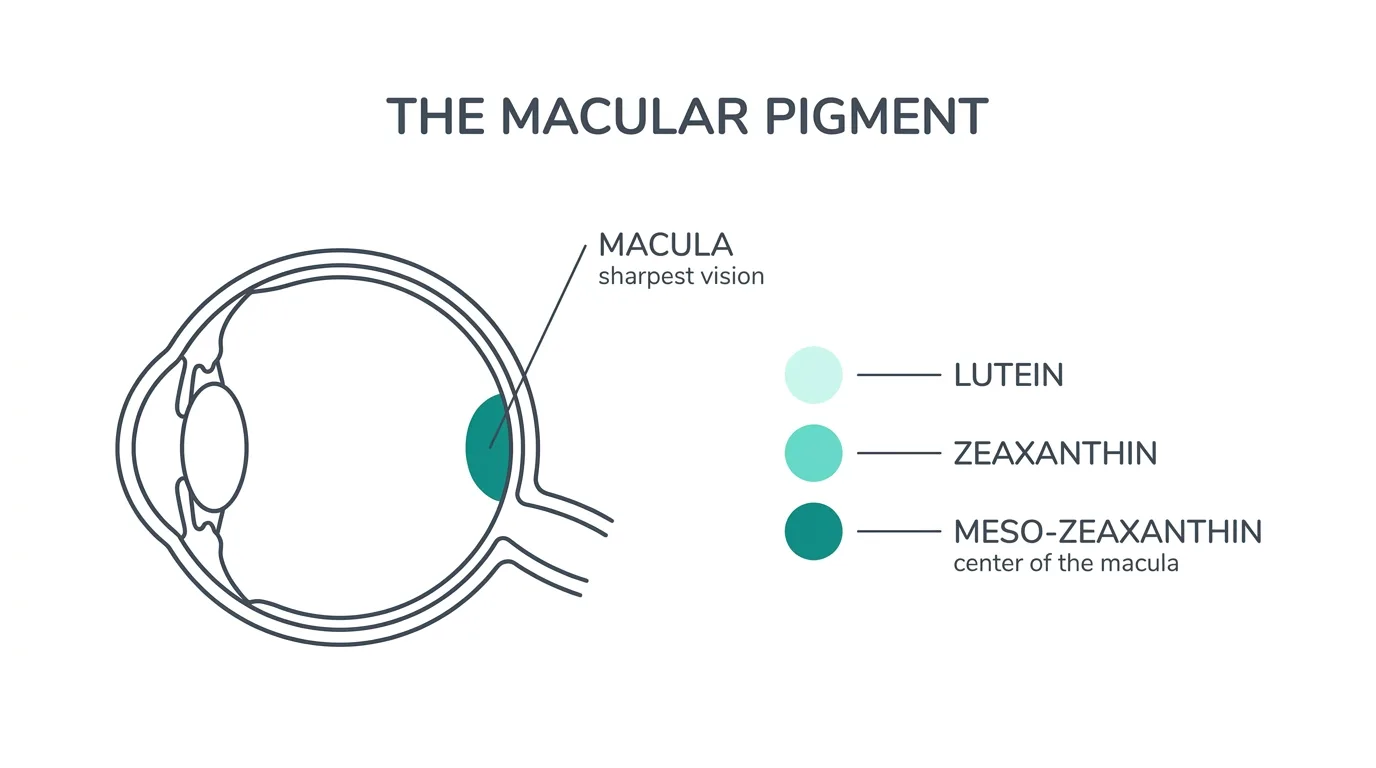
The thing that makes eye nutrition different is a small structure at the back of your eye called the macula. It is about the size of a dime, and it is the only part of your eye capable of sharp, detailed vision.
Reading a menu, recognizing a face across a room, telling a 3 from an 8 on a dashboard, that is all the macula.
The macula protects itself with a layer of yellow pigment. That pigment is built from three specific plant carotenoids.
Your body cannot manufacture them. You either eat them, supplement them, or slowly run low on them.
A multivitamin does not contain them in any meaningful amount, because it was never designed to.
So when I assess an "eye vitamin," I am really checking one thing: does it deliver what the macula and the surrounding eye actually use, or is it a multivitamin with better marketing? Three ingredients answer that question.
2.The three things a real eye vitamin has
1. Meso-zeaxanthin, the third pigment
The yellow pigment in your macula is made of lutein, zeaxanthin, and meso-zeaxanthin. Most "eye vitamins" include the first two and stop there. They skip the third.
That matters, because meso-zeaxanthin is the dominant pigment at the very center of the macula, the tiny spot responsible for your sharpest vision. It is also the part of the retina that tends to thin first.
A formula with lutein and zeaxanthin but no meso-zeaxanthin is missing the pigment most concentrated exactly where it counts most.
If the back of the bottle does not say meso-zeaxanthin, that is the first tell.
2. Astaxanthin, for the focus muscle
Look at this page, then across the room, then back. A small ring of muscle inside your eye, the ciliary muscle, reshaped your lens each time.
After eight hours at a screen, that muscle fatigues, and your vision smears for a moment when you look up from your work.

Astaxanthin, a deep-red pigment from a microalga, concentrates in that focus muscle. Clinical trials have shown it reduces eye strain and improves focus endurance.
A multivitamin contains none of it. Most eye vitamins contain none of it either. That is the second tell.
3. Active-form B-vitamins, for the eye's blood supply
The optic nerve carries vision from your eye to your brain, and it runs on a network of very small blood vessels.
A large analysis from the Women's Antioxidant and Folic Acid Cardiovascular Study found that a combination of folic acid, vitamin B6, and vitamin B12 was associated with a lower incidence of age-related macular degeneration over several years.
(That trial used higher B-vitamin doses than most supplements contain, so read it as support for the B-vitamin approach, not a guaranteed result.)
Here is the catch a label hides. Plenty of multivitamins contain B-vitamins, but in inactive forms the body has to convert before it can use them.
Many adults carry a common genetic variant (MTHFR) that makes that conversion less efficient.
Active forms - methylfolate, methylcobalamin, and P5P - are ready to use. They cost more, so most products do not bother.
The third tell is not just whether B-vitamins are present, but what form they are in.
3.Two more things the label quietly tells you
Beyond the three ingredients, two details separate a serious formula from a cheap one.
Zinc form. The older formulas use zinc oxide, which is cheap, poorly absorbed, and the most common reason people get a queasy stomach and quietly stop taking their eye vitamin.
Zinc citrate is better absorbed and far gentler. If the label says oxide, that is a cost decision, not a science one.
Beta-carotene. It was shown to raise lung cancer risk in current and former smokers, and the AREDS2 formula removed it in 2013.
Yet some general eye products still contain it. For any smoker or former smoker, that is a real reason to read the label. If you are weighing the newer version on the shelf, here is how AREDS3 compares with AREDS2.
"I had no idea the eye vitamin I'd bought for six years was basically a multivitamin. The front of the bottle told me one thing. The back told me another."

4.What a real eye vitamin looks like
When I came across Klaris, I did what I do with every bottle. I read the back first. It was not a multivitamin in disguise. It was built to the spec the research actually points to.
What is in the Klaris Supplement
- Lutein 10 mg (from marigold)
- Zeaxanthin 2 mg (from marigold)
- Meso-zeaxanthin 10 mg
- Astaxanthin 4 mg (from red algae)
- Vitamin C 250 mg
- Vitamin E 134 mg
- Active Vitamin B6 2 mg
- Methyl folate 400 mcg DFE
- Methylcobalamin (B12) 250 mcg
- Zinc citrate 25 mg
- Copper citrate 2 mg
Eleven ingredients. All three macular carotenoids. Astaxanthin for the focus muscle. Active B-vitamins. Gentle citrate minerals. No beta-carotene. Plant-based throughout, produced in an FDA-registered, GMP-certified facility.
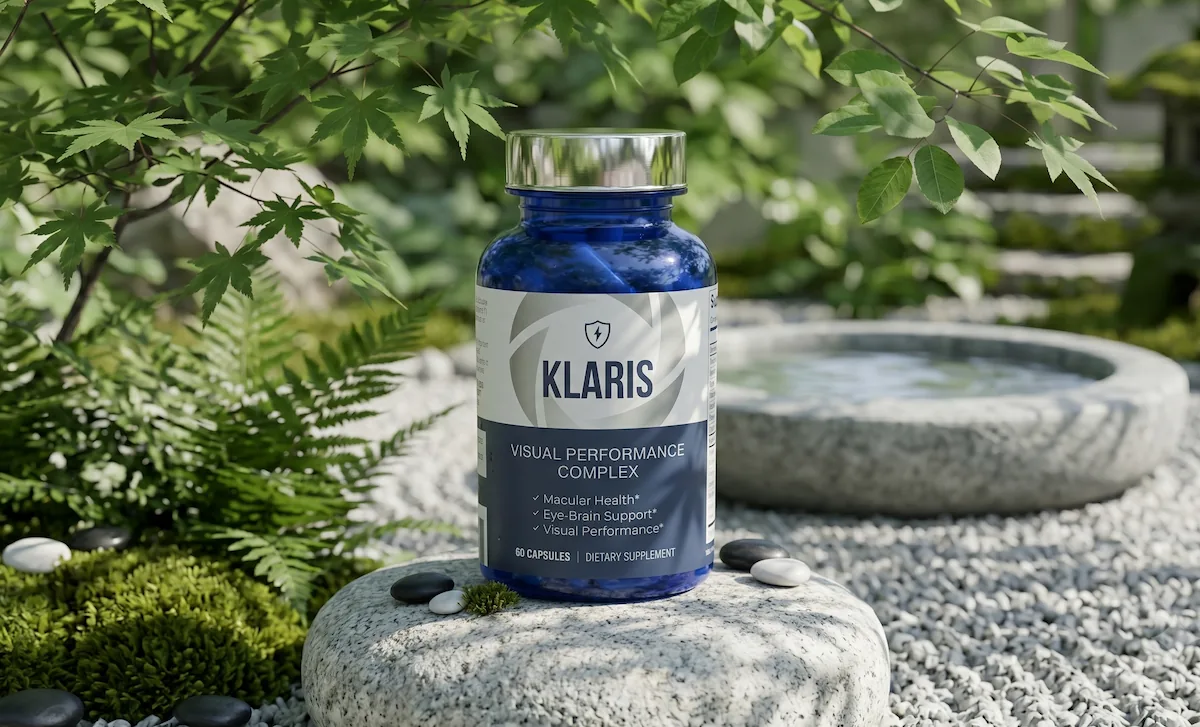
That is the difference between an eye vitamin and a multivitamin with an eye on the label. It is not the front of the bottle. It is the back.
5.The bottom line
There is nothing wrong with a multivitamin. If that is what you want, buy one, and pay multivitamin prices for it.
But if you are paying a premium for an eye vitamin, it should do something a multivitamin cannot.
Before you reorder, flip the bottle over.
- Look for meso-zeaxanthin.
- Look for astaxanthin.
- Look at what form the B-vitamins and the zinc are in.
If most of that comes up blank, you are paying eye-vitamin prices for a multivitamin, and your eyes are not getting the part that was supposed to justify the cost.
This article is for general educational purposes and is not medical advice. If you have a diagnosed eye condition or are on medications, please discuss any new supplement with your eye care professional. These statements have not been evaluated by the Food and Drug Administration. Klaris is not intended to diagnose, treat, cure, or prevent any disease.
References
- Age-Related Eye Disease Study 2 (AREDS2) Research Group. JAMA. 2013.
- Nolan JM, et al. Macular pigment and visual performance in subjects with age-related macular degeneration. Curr Eye Res. 2016.
- Hammond BR, et al. The effects of macular pigment on visual performance. Vision Res. 2014.
- Christen WG, et al. Folic acid, B6, and B12 in combination and age-related macular degeneration. Arch Intern Med. 2009.
About the author
Neuro-ophthalmology, 20+ years in clinical practice
Dr. Markovic reviews every Klaris article for medical accuracy. Her clinical focus is age-related vision change, macular pigment and the nutrition behind both. Read Dr. Markovic’s full profile.