AREDS2 vs AREDS3: What Actually Changed (And Whether You Should Switch)
There is no clinical trial showing that AREDS3 slows macular degeneration. Not because the results were disappointing - because the trial has not been run.
"The formula changed for the first time in over a decade. What did not change is who it was built for." - Dr. Elena Markovic, neuro-ophthalmology specialist
1. What AREDS3 Actually Is
For twenty-five years, one formula has dominated the eye vitamin shelf. It came out of the Age-Related Eye Disease Study, run by the National Eye Institute, and everyone shortened it to AREDS.
In 2013 it was updated to AREDS2. On 19 May 2026, Bausch + Lomb launched a third version and called it PreserVision AREDS3.
Two things changed. Everything else stayed the same.
Retinal Physician put it plainly in May 2026: "No dedicated clinical trial has yet evaluated whether PreserVision AREDS3 slows AMD progression." Bausch + Lomb has described a long-term study as being in planning.
That does not make AREDS3 a bad product. It means the AREDS2 nutrients inside it are still the only part with outcome data behind them, and the new parts are a reasonable hypothesis.
2. The Two Changes, Side By Side
| Per daily serving | AREDS2 (as the NEI lists it) | PreserVision AREDS3 |
|---|---|---|
| Lutein | 10 mg | 10 mg |
| Zeaxanthin | 2 mg | 2 mg |
| Vitamin C | 500 mg | 500 mg |
| Vitamin E | 400 IU (180 mg) | 180 mg |
| Zinc | 80 mg | 25 mg |
| Copper | 2 mg | 2 mg |
| B vitamins | None | Eight: B1, B2, B3, B5, B6, B7, B9, B12 |
| Meso-zeaxanthin | None | None |
| Astaxanthin | None | None |
- AREDS2 (as the NEI lists it)
- 10 mg
- PreserVision AREDS3
- 10 mg
- AREDS2 (as the NEI lists it)
- 2 mg
- PreserVision AREDS3
- 2 mg
- AREDS2 (as the NEI lists it)
- 500 mg
- PreserVision AREDS3
- 500 mg
- AREDS2 (as the NEI lists it)
- 400 IU (180 mg)
- PreserVision AREDS3
- 180 mg
- AREDS2 (as the NEI lists it)
- 80 mg
- PreserVision AREDS3
- 25 mg
- AREDS2 (as the NEI lists it)
- 2 mg
- PreserVision AREDS3
- 2 mg
- AREDS2 (as the NEI lists it)
- None
- PreserVision AREDS3
- Eight: B1, B2, B3, B5, B6, B7, B9, B12
- AREDS2 (as the NEI lists it)
- None
- PreserVision AREDS3
- None
- AREDS2 (as the NEI lists it)
- None
- PreserVision AREDS3
- None
The zinc dropped from 80 mg to 25 mg, and eight B vitamins were added. That is the entire change.
3. Change One: The Zinc Came Down
This is the better of the two changes, and it gets less attention than the B vitamins.
The 80 mg zinc dose comes from the original study, which began in the 1990s. For context, the Daily Value for zinc is 11 mg - the AREDS dose is more than seven times that.
- At that level, zinc is the most common reason people stop taking eye vitamins.
- Stomach upset is the usual complaint.
- A 2007 analysis of the original AREDS data also found more hospital admissions for urinary problems among participants taking zinc, 11.1% against 7.6% for those who were not, with men at the greatest risk.
AREDS2 did test a lower dose. It compared 80 mg against 25 mg, and in the National Eye Institute's own words, the investigators "did not find a difference in the effects of 80 mg vs. 25 mg zinc."

Read that carefully in both directions. "No difference found" is not the same as "25 mg proven equivalent." That comparison was a secondary part of the trial and it had no placebo group, which is exactly why the NEI still publishes 80 mg as the AREDS2 formula.
What you can fairly say is that the lower dose did not perform worse in the one trial that looked at it, and that it is easier to keep taking. A supplement you abandon protects nothing.
4. Change Two: Eight B Vitamins

The B complex is the headline of the launch, and it is where a reader should slow down.
The idea is sound in principle. B6, folate and B12 lower homocysteine, and higher homocysteine has been associated with macular degeneration in observational research. Lowering it is a plausible thing to want.
The evidence underneath is thinner than the marketing suggests, in three specific ways.
- The supporting review is a commentary, not a trial. Published in Ophthalmology and Therapy in 2025, its journal fee was funded by Bausch + Lomb, and all three authors disclose Bausch + Lomb relationships. Its own conclusion describes an "emerging" and "potential" role.
- The one randomised trial behind it studied a different population. A 2009 study followed 5,205 women for an average of 7.3 years and found 34% fewer cases of macular degeneration in the group taking folic acid, B6 and B12. That is a real result. But it was a cardiovascular trial, in women at high heart-disease risk, and every participant started with no macular degeneration - the exact group the NEI says AREDS supplements do not help.
- The dose does not match. That trial used 2.5 mg of folic acid. AREDS3 contains 900 mcg - roughly 2.8 times lower.
None of this makes B vitamins a bad addition. It means anyone presenting the 34% figure as an AREDS3 benefit is stretching it well past what the study showed.
5. What The "2x Absorption" Claim Means
AREDS3 is marketed as providing "two times better absorption of key nutrients."
The footnote on the pack tells you what that is measured against: the area-under-curve blood level of lutein and zeaxanthin, compared with Bausch + Lomb's own older PreserVision AREDS 2 soft gel.
The published study behind the underlying delivery technology tested
- 90 healthy adult men,
- on a single dose,
- measuring blood levels only,
- against a generic commercial lutein blend rather than the older PreserVision softgel.
- It was funded by the ingredient supplier.
So more of the nutrient reaches the bloodstream. That is genuinely useful - a carotenoid has to get into your blood before it can reach your macula.
What it does not tell you is whether more of it reaches the macula, or whether any of it changes how well you see. Absorption is a step on the way to a benefit. It is not the benefit.
6. Should You Switch? Three Situations

If your eye doctor put you on AREDS2
Ask them before changing anything, and do not switch on your own. The NEI is specific that the AREDS 2 formula is for people with intermediate macular degeneration in one or both eyes, or late AMD in one eye.
AREDS3 changes the zinc dose inside that formula and has not been tested for the same outcome. This is a conversation for your next appointment.
If you take AREDS2 and the zinc upsets your stomach
Raise the lower-zinc option with your doctor. This is the clearest reason AREDS3 exists, and the most honest thing in its favour.
Tell them you have been skipping doses - that is information they want, and it changes what they offer you.
If nobody has diagnosed you and you take it as a precaution
This is where most people actually are, and it is worth knowing what the National Eye Institute says about it, in writing, about its own formula:
"AREDS 2 supplements can't prevent early AMD from developing into intermediate AMD." And: "There was no benefit for people with early AMD or for people who do not have AMD."
AREDS formulas - including AREDS3 - were built as a clinical intervention for a defined group of patients. If you are not in that group, the 80 mg or 25 mg of zinc and the 500 mg of vitamin C are not doing the preventive job the pack implies.
That does not mean carotenoids stop mattering when you do not have a diagnosis. It means the AREDS dose structure was designed around a different question than the one you are asking.
7. What Neither Formula Contains
Two ingredients are absent from AREDS, the 2013 AREDS2 recipe most eye vitamins still copy and AREDS3 alike.
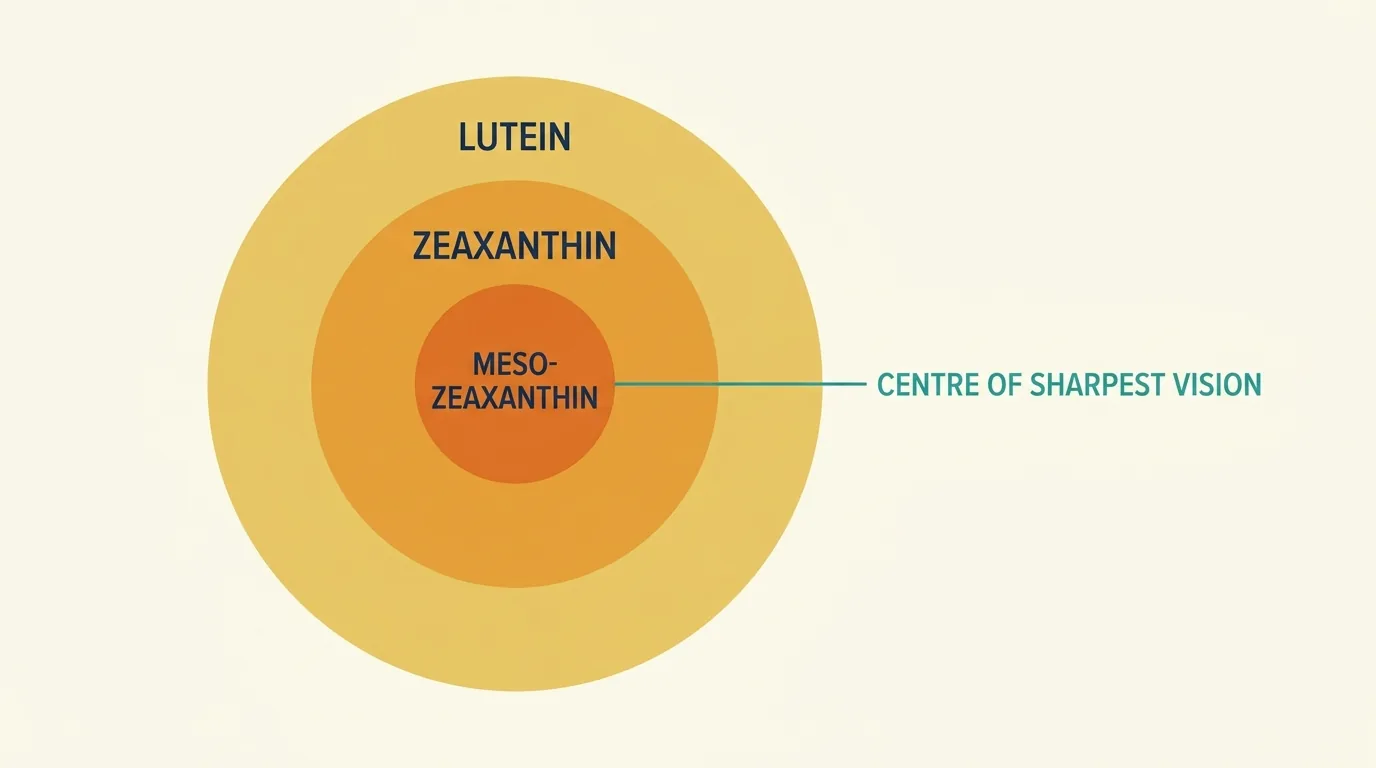
Meso-zeaxanthin. The third macular carotenoid, and the one your body concentrates at the very centre of the macula - the part you use to read a label or recognise a face across a room.
Your retina makes it from lutein. For roughly one in five people, that conversion does not raise macular pigment at all, no matter how much lutein they take.
The bottleneck is in the retina, not in absorption: their blood levels of lutein are usually fine. In the CREST trial, supplementing all three carotenoids together improved contrast sensitivity over twelve months in people free of retinal disease.
This matters more than a missing ingredient usually does. Macular pigment is what filters and steadies the light hitting the centre of your vision, and its density is strongly linked to glare recovery and to contrast under glare - how quickly your eyes settle after oncoming headlights, and how clearly you pick out an edge in poor light.
Research has also found that supplementing all three carotenoids together raises macular pigment more than lutein and zeaxanthin alone.
Astaxanthin. Also in none of them. Its human research sits in visual comfort and eye fatigue, particularly among people doing long days on screens, rather than in macular degeneration.
Astaxanthin has been studied in around ten Japanese randomised trials for eye strain and accommodative fatigue in screen users, and it is one of the most potent antioxidants ever measured in a laboratory assay - its singlet-oxygen quenching capacity is roughly 6,000 times that of vitamin C.
That is a test-tube measurement of chemical potency, not a claim about what happens inside your eye, and it belongs in the visual-comfort conversation rather than the macular degeneration one.

8. How Klaris Is Built Differently
| Per daily serving | PreserVision AREDS3 | Klaris |
|---|---|---|
| Lutein | 10 mg | 10 mg |
| Zeaxanthin | 2 mg | 2 mg |
| Meso-zeaxanthin | None | 10 mg |
| Astaxanthin | None | 4 mg |
| Zinc | 25 mg | 25 mg, as zinc citrate |
| Copper | 2 mg | 2 mg, as copper citrate |
| Vitamin C | 500 mg | 250 mg |
| Vitamin E | 180 mg | 134 mg |
| Beta-carotene | None | None |
| Built for | People with intermediate or late AMD, on a doctor's advice | Everyday macular pigment support in people without a diagnosis |
- PreserVision AREDS3
- 10 mg
- Klaris
- 10 mg
- PreserVision AREDS3
- 2 mg
- Klaris
- 2 mg
- PreserVision AREDS3
- None
- Klaris
- 10 mg
- PreserVision AREDS3
- None
- Klaris
- 4 mg
- PreserVision AREDS3
- 25 mg
- Klaris
- 25 mg, as zinc citrate
- PreserVision AREDS3
- 2 mg
- Klaris
- 2 mg, as copper citrate
- PreserVision AREDS3
- 500 mg
- Klaris
- 250 mg
- PreserVision AREDS3
- 180 mg
- Klaris
- 134 mg
- PreserVision AREDS3
- None
- Klaris
- None
- PreserVision AREDS3
- People with intermediate or late AMD, on a doctor's advice
- Klaris
- Everyday macular pigment support in people without a diagnosis
Four differences are worth understanding rather than just reading off a table.
The third carotenoid, taken directly
Your retina makes meso-zeaxanthin from lutein. For roughly one in five people that conversion does not raise macular pigment at all - they are described as retinal non-responders, and the bottleneck sits in the retina rather than in absorption.
Their blood levels of lutein are usually perfectly good; the pigment simply does not build. Klaris includes 10 mg of meso-zeaxanthin directly, which skips the step entirely.
The form of the zinc, not just the dose
Both AREDS3 and Klaris contain 25 mg of zinc. They are not the same 25 mg. Most eye vitamins use zinc oxide, which is poorly absorbed and more likely to cause stomach upset than zinc citrate.
Klaris uses zinc citrate, with 2 mg of copper as copper citrate alongside it. Dose is the number people compare; form is the part that decides whether you keep taking it.
B vitamins in their active forms
Klaris uses three B vitamins rather than eight, in the forms the body uses directly: B6 as pyridoxal 5'-phosphate, folate as L-methylfolate, and B12 as methylcobalamin.
This matters because many adults carry a common variant (MTHFR) that makes converting inactive folate less efficient. Fewer B vitamins, in forms that do not require conversion.
No beta-carotene, ever
Klaris has never contained beta-carotene - the ingredient AREDS2 removed in 2013 after it was linked to higher lung cancer risk in current and former smokers. Worth checking on whatever you are taking now, because some older formulas still include it.

Klaris is not an AREDS2 formula and is not sold as one. It carries less vitamin C and less vitamin E than the AREDS doses, and it is not a substitute for a formula your eye doctor prescribed.
It is built around the three macular carotenoids plus astaxanthin, with 25 mg of zinc as zinc citrate - a form that is better absorbed and gentler on the stomach than the zinc oxide used in most eye vitamins - for people who have not been diagnosed with macular degeneration and want to support the pigment that protects the centre of their vision.
9. What To Look For On Any Eye Vitamin Label
Whatever you decide to take, these are the five things worth checking before you buy. They apply to any brand, including ours.
- Does it contain meso-zeaxanthin, and how much? The third macular carotenoid is absent from every AREDS formula. Many products list only lutein and zeaxanthin.
- How much zinc, and in which form? The form appears in brackets after the word Zinc in the Supplement Facts panel. Oxide and citrate behave differently at the same dose.
- Is copper included alongside the zinc? Every AREDS formula includes 2 mg. A high-zinc product without copper is a gap.
- Are the carotenoid amounts the actives, or the extract weights? "Lutein 10 mg" and "10 mg of a 5% lutein extract" are very different things. If a label is ambiguous, ask the company before buying.
- Does it claim to treat or prevent macular degeneration? No supplement can legally make that claim. A brand that does is telling you something about itself.
11. References
- Age-Related Eye Disease Study Research Group. A randomized, placebo-controlled clinical trial of high-dose supplementation with vitamins C and E, beta carotene, and zinc for age-related macular degeneration and vision loss: AREDS Report No. 8. Arch Ophthalmol. 2001;119(10):1417-1436.
- Age-Related Eye Disease Study 2 Research Group. Lutein + zeaxanthin and omega-3 fatty acids for age-related macular degeneration: the AREDS2 randomized clinical trial. JAMA. 2013;309(19):2005-2015.
- National Eye Institute. AREDS/AREDS2 Frequently Asked Questions. nei.nih.gov
- National Eye Institute. Nutritional Supplements for Age-Related Macular Degeneration. nei.nih.gov
- Bausch + Lomb. Bausch + Lomb Launches PreserVision AREDS3 Eye Vitamins in the United States. 19 May 2026.
- The Evolution of AREDS. Retinal Physician. May/June 2026.
- Bausch + Lomb launches PreserVision AREDS3 eye vitamins in US. Optometry Times. May 2026.
- Johnson AR, Munoz A, Gottlieb JL, Jarrard DF. High dose zinc increases hospital admissions due to genitourinary complications. J Urol. 2007;177(2):639-643.
- Poteet J, Koetting C, Vakharia PS. Role of B vitamins in preventing the development and progression of age-related macular degeneration. Ophthalmol Ther. 2025.
- Christen WG, Glynn RJ, Chew EY, Albert CM, Manson JE. Folic acid, pyridoxine, and cyanocobalamin combination treatment and age-related macular degeneration in women. Arch Intern Med. 2009;169(4):335-341.
- Kotagiri SR, Morde A, Rai D, et al. Superior bioavailability of a novel lutein and zeaxanthin formulation in healthy human subjects. Ophthalmol Ther. 2022;11(4):1463-1477.
- Nolan JM, Power R, Stringham J, et al. Enrichment of macular pigment enhances contrast sensitivity in subjects free of retinal disease: Central Retinal Enrichment Supplementation Trials - Report 1. Invest Ophthalmol Vis Sci. 2016;57(7):3429-3439.
Keep reading


About the author
Neuro-ophthalmology, 20+ years in clinical practice
Dr. Markovic reviews every Klaris article for medical accuracy. Her clinical focus is age-related vision change, macular pigment and the nutrition behind both. Read Dr. Markovic’s full profile.